What Is an AI Scraper? a Guide for Developers (2026)
You're staring at a page full of cookie banners, nav links, ad slots, and nested divs, and your LLM is supposed to pull the one paragraph that matters. It's a familiar failure mode, raw HTML goes in, noise comes back out, and the model burns context on junk instead of signal. That's the gap an AI scraper closes, it extracts the meaningful page content in a form an LLM can effectively use.
The Problem AI Scrapers Were Built to Solve
The first time a team feeds raw page HTML into a retrieval pipeline, the failure is usually obvious. The model sees navigation, footers, cookie notices, related links, and tracking scripts, then tries to answer a question from a pile of irrelevant markup. That's not a model problem, it's an extraction problem.
An AI scraper exists to solve that exact pain. Instead of treating a webpage like a bag of tags, it treats the rendered page like a human would, then returns only the content that matters for downstream reasoning. That shift matters most when the output needs to feed a RAG system, an agent, or any workflow where every extra token costs attention.
Practical rule: if your retrieval layer can't separate the article body from boilerplate reliably, your LLM is doing cleanup work it should never have been asked to do.
The business case isn't niche anymore. The web scraping market is valued at USD 1.34 billion in 2025 and is projected to reach USD 3.49 billion by 2031 according to Mordor Intelligence's web scraping market overview. That growth lines up with the reality developers already see, AI teams, ecommerce operators, finance workflows, SEO tooling, and research systems all need fresh web data at scale.
If you're looking at the broader AI search stack, Sight AI's AEO insights are a useful companion read because they frame why answer-ready content matters once models start consuming live web sources. For a practical entry point into the broader data layer, the Web Search API pattern shows how search and extraction often get chained together in production.
The point is simple. Modern AI systems don't just need access to the web, they need clean context from the web. That's the job an AI scraper was built to do.
Why Traditional Scrapers Fail in the AI Era
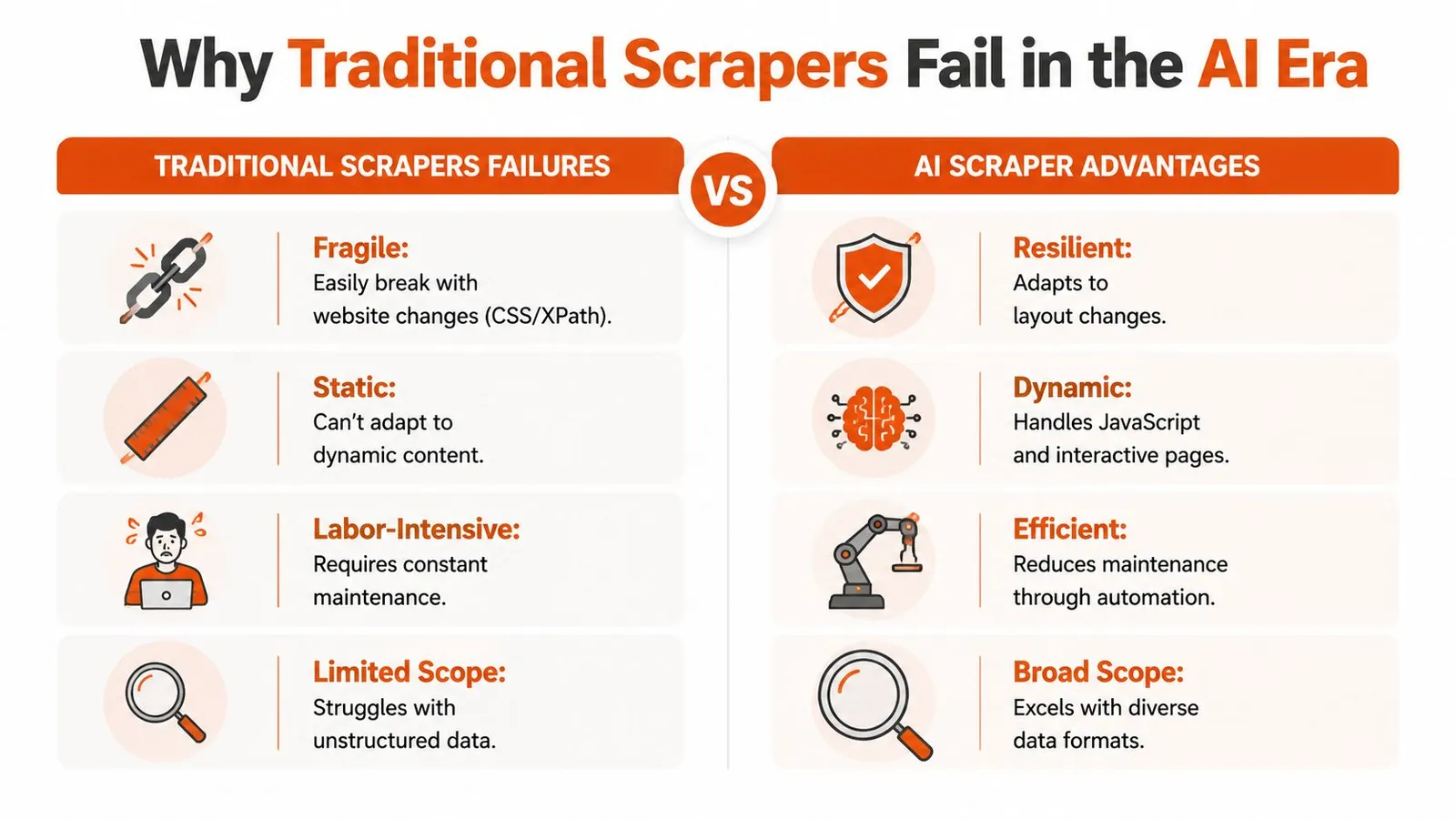
A legacy scraper can still look fine in a demo and fail in production five minutes later. It depends on selectors that assume the page structure will stay stable, so a class rename, a layout tweak, or a hidden content swap can break the extraction path without warning.
Bot defenses changed the actual problem
Modern websites do more than serve HTML. They challenge requests, check browser behavior, and block traffic that looks automated. As IBM's AI scraping overview explains, the problem is no longer just parsing markup, it is getting reliable access to content that is protected, dynamic, or both.
A plain HTTP client also misses pages that only become useful after JavaScript runs. The request can succeed, the logs can look clean, and the scraper still returns an empty shell because the visible content never existed in the initial response. That creates false confidence and sends teams chasing parser bugs when the underlying issue is rendering and access control.
Undetected browser behavior matters here too. Tools and workflows built around undetectable internet browser setup exist because some sites inspect signals that go beyond headers and cookies, and a scraper that cannot handle those checks is easy to stop.
A scraper that only works on static HTML is not ready for the modern web.
The same pressure shows up in media workflows too. If you have dealt with browser-level constraints in extraction or automation, automating yt-dlp geo restrictions shows how location rules and access checks can shape the whole workflow, not just the last parsing step.
Raw HTML is the wrong output for LLM systems
Even a scraper that gets through the defenses can still deliver the wrong artifact. Raw HTML is noisy, repetitive, and bulky for many LLM workflows. The model usually does not need the full DOM tree, it needs the article body, a product spec, table rows, or other semantic pieces that can be passed into retrieval, summarization, or agent logic without extra cleanup.
That mismatch is why older pipelines waste effort. They are built to collect markup, while AI systems need meaningful, compact context that stays easy to rank, chunk, and embed. Once the output has to feed a RAG system or an agent, messy HTML becomes an operational cost, not a harmless formatting issue.
The Core Architecture of an AI Scraper
Think of a traditional scraper as a blind robot reaching for a known doorknob. An AI scraper is closer to a researcher who can see the whole room, recognize the exit, and ignore the furniture that doesn't matter. The architectural difference is what lets it survive messy layouts and still return useful output.
Browser rendering comes first
The first layer is a real browser environment, usually headless, that can execute JavaScript and observe the page the way a user would. That matters because many modern pages don't expose their useful content in the initial HTML response. They hydrate later, load data through client-side calls, or gate elements behind interactive states.
For pages like that, the scraper has to render, wait, and often manage stateful interactions rather than just fetch and parse. Research on protected and dynamic sites shows that for heavy JavaScript, authentication, or CAPTCHA, end-to-end systems that combine browser rendering and state handling are the only ones that consistently succeed, while traditional HTML parsing falls short arXiv study.
Semantic extraction turns page structure into meaning
Once the page is visible, the next layer identifies what's important. That can involve model-driven page segmentation, layout understanding, text classification, and content ranking. The goal isn't to preserve the DOM, it's to identify semantic blocks like a product description, a review section, a pricing table, or a main article body.
AI scrapers diverge from selector-based tools because they don't depend on a single CSS path to one element. Instead, they use page context and content cues to decide what belongs in the output, which makes them more resilient when site owners redesign templates or shuffle sections around.
A useful mental model is this, the scraper stops asking, “What tag is the target in?” and starts asking, “What part of this page is the target?”
| Capability | Traditional Scraper, for example BeautifulSoup or Scrapy | AI Scraper, for example Webclaw |
|---|---|---|
| Page access | Basic HTTP fetch, limited browser behavior | Browser-aware rendering and navigation |
| Extraction method | CSS selectors, XPath, rigid rules | Semantic extraction by meaning and layout |
| Maintenance | Manual updates when structure changes | Less selector maintenance, more adaptive handling |
| Output shape | Raw HTML or lightly parsed text | Clean Markdown, JSON, or LLM-ready text |
| Best fit | Stable, simple pages | Dynamic, messy, or protected pages |
For teams evaluating production APIs, the AI Web Extraction API pattern is useful because it's built around the idea that the output should already be shaped for the next step.
Output formatting is part of the product
The final layer is formatting. The best AI scrapers don't stop at extraction, they condense and normalize the result into a compact format like Markdown or structured JSON. That matters because LLM pipelines care about token efficiency, not just completeness.
Industry comparisons note that AI scrapers trade latency and cost for better extraction quality and smaller, LLM-ready outputs that reduce downstream token usage NextGrowth's comparison of scraping tools. In practical terms, you pay more to get less noise, and that's often the right trade when context quality is the bottleneck.
Key Techniques for Robust AI Scraping
The difference between a toy extractor and a production system usually comes down to resilience. A scraper that works on a demo site but fails on the first defended target doesn't solve much. Effective AI scraping depends on techniques that account for access friction, rendering complexity, and output hygiene.
Access needs to look like real browsing
Modern bot protection doesn't stop at a user-agent string. It can inspect browser behavior, request patterns, rendering behavior, and other access signals. That's why resilient extraction often relies on full browser execution, careful state handling, and access paths that can survive guarded sites. In practice, you often need proxy strategy, browser automation, and timing control together rather than as separate hacks.
For teams building around this, the important question isn't whether you can send a request. It's whether you can keep the session believable enough to receive the content consistently. That's also why browser-backed workflows outperform bare-bones fetchers when the target site cares about interaction state.
Dynamic content has to be rendered, not guessed
JavaScript-rendered pages are common enough now that “just parse the HTML” is a dead-end on many targets. The scraper needs to wait for the useful content to arrive, then identify which DOM changes correspond to the data you want. That often means observing the page after scripts run, not before.
The architecture described in the earlier section matters here because rendering isn't a convenience, it's a prerequisite. If the page has authentication walls, CAPTCHA, or heavy client-side behavior, the extraction stack has to behave like a browser plus a parser, not a request library with optimism.
For access-heavy workflows, a residential backconnect proxy is one of the common building blocks people evaluate alongside rendering strategy.
Extraction quality should survive messy text
A strong AI scraper also needs to strip boilerplate cleanly. The value isn't just that it finds the main content, it's that it removes the surrounding clutter without throwing away important structure. That's what makes the output usable in downstream retrieval, summarization, and agent planning.
Practical rule: if the output can't be pasted into a prompt without extra cleanup, the scraper isn't done.
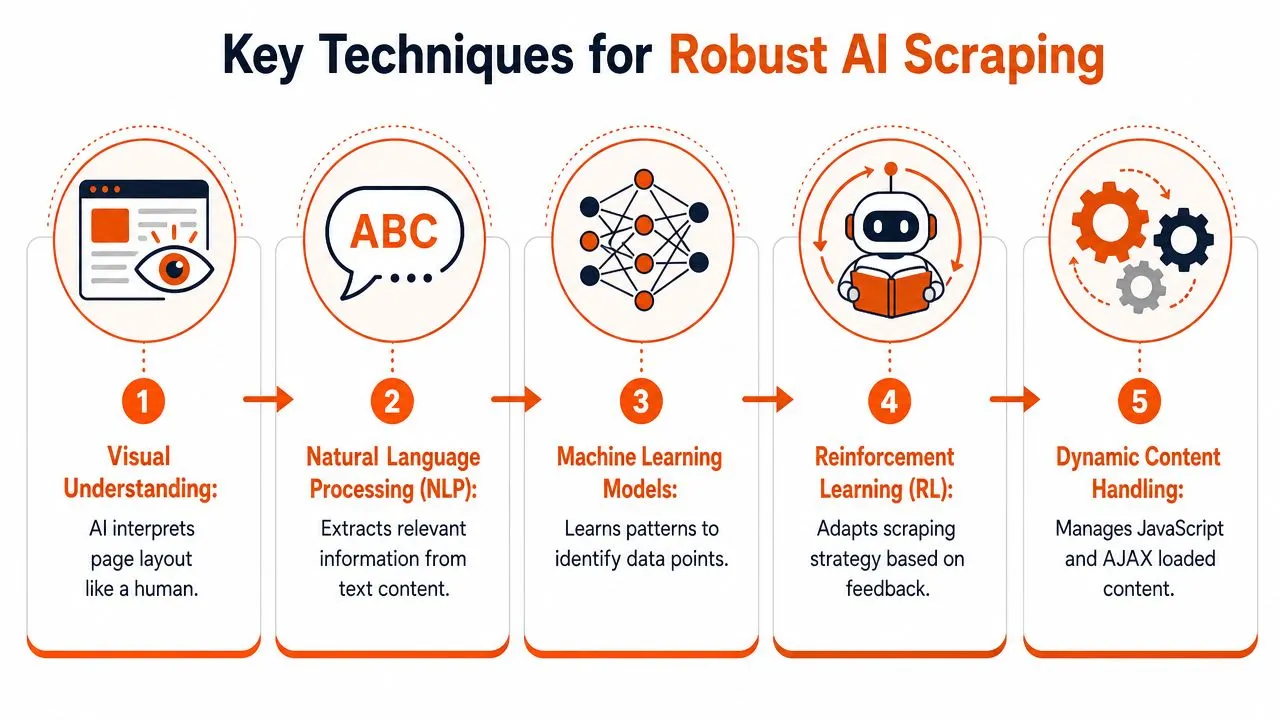
Techniques like visual understanding and NLP complement each other. Visual cues help the system recognize page regions, while language models help it determine which text segments are semantically relevant. Combined with learned extraction behavior, that's how an AI scraper gets past the brittle rules that traditional tools depend on.
Practical Use Cases and Integration Patterns
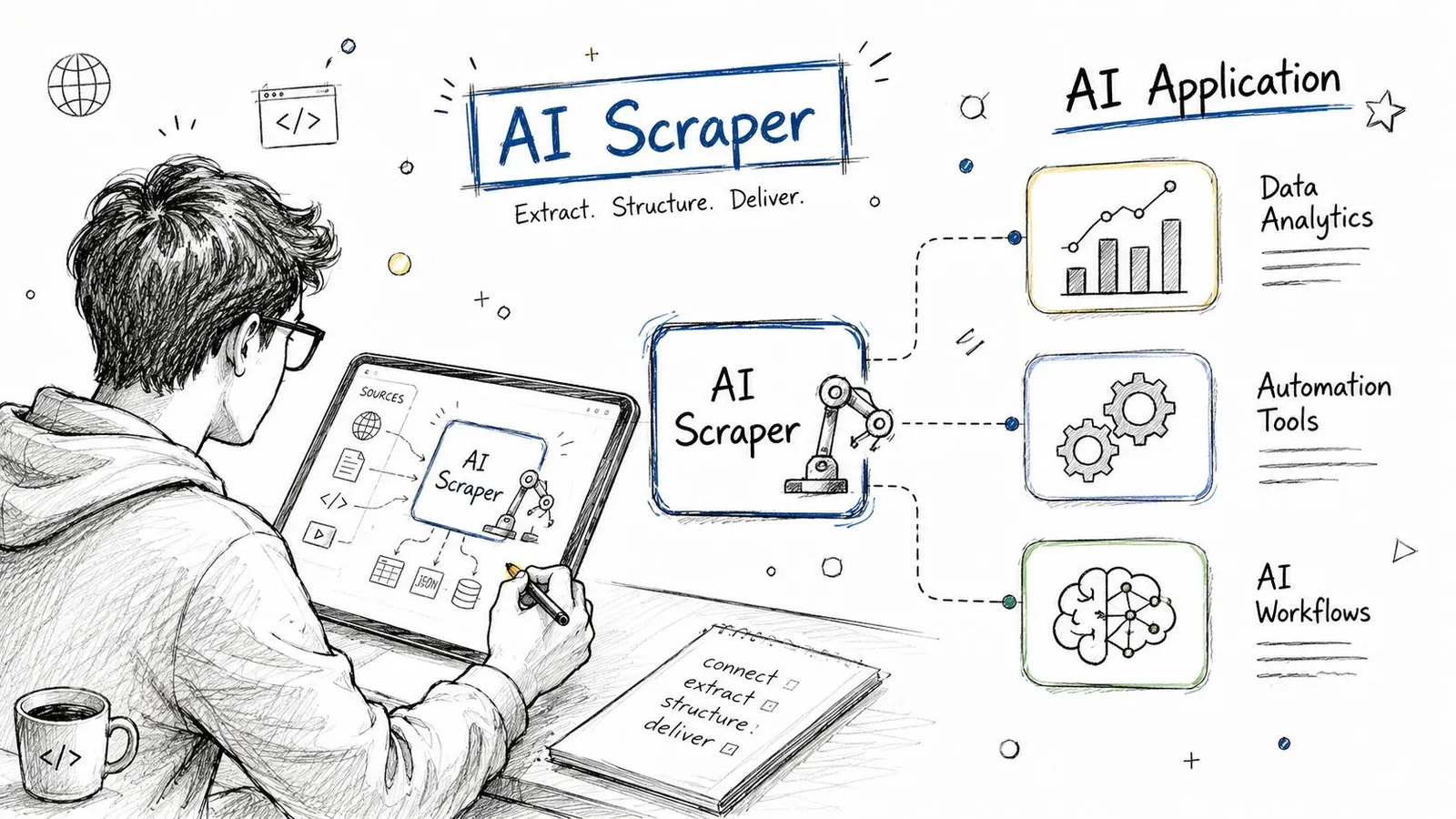
The cleanest way to think about an AI scraper is as the intake layer for other AI systems. It usually is not the final product. It sits upstream of retrieval, agent reasoning, monitoring, and analysis, and its job is to make the next step simpler, cleaner, and more reliable.
RAG pipelines need clean retrievers
In a Retrieval-Augmented Generation workflow, the scraper often feeds the retriever. It fetches fresh web pages, strips out noise, and passes clean content into indexing or chunking steps. If the upstream text is messy, the vector store inherits that mess.
That is why the RAG pipeline use case fits AI-native extraction so well. The more accurately the scraper isolates the main content, the less the retriever has to compensate later. In practice, that means fewer irrelevant chunks, less prompt bloat, and cleaner answers.
Agents need web vision, not just web access
Autonomous agents need something closer to perception than scraping. They have to understand what is on the page, decide whether it matters, and then act on it. An AI scraper gives them page context in a form they can reason over without reading through a wall of boilerplate.
That matters for monitoring, research, and workflow automation. A research agent can use scraped pages to compare product details, inspect documentation, or track changes on target sites without human cleanup between each step. The scraper becomes the agent's eyes, while the model handles judgment.
Market research becomes less manual
Competitor monitoring and market research are also strong fits. Teams can extract product pages, pricing pages, news articles, or category listings and normalize them into structured datasets. That replaces a lot of manual copy-paste work and lowers the chance that an analyst misses changes hidden behind page chrome.
For teams building search-driven ingestion, SupportGPT for scalable search data is a relevant reference point because search result acquisition often sits beside content extraction in the same workflow. That is one reason the boundary between search, scrape, and summarize keeps getting thinner in production systems.
The common thread across all of these patterns is the same. You want the scraper to return usable context, not just data. Once that is true, RAG, agents, and research workflows get easier to maintain and more predictable.
Implementation Notes and Ethical Guidelines
The fastest path to a working system is usually an API, not a custom crawler stack. Self-hosting means owning browser orchestration, retries, proxy logic, storage, monitoring, and constant repair when targets change. A managed extraction layer reduces that operational burden by turning a URL into clean output with far less glue code.
The build-versus-buy trade-off is simple in practice. If your team needs one-off control over a stable site, a local pipeline can be enough. If you need to reach blocked, dynamic, or brittle sites on an ongoing basis, the time saved with a managed service can matter more than the control you give up.
A sensible implementation pattern
Start with a simple contract, submit a URL, receive structured text or Markdown, then store the result where your pipeline expects it. After that, validate the output with schema checks or lightweight heuristics before it touches your retriever or agent layer. That extra validation catches malformed extractions early and keeps bad pages from cascading into downstream logic.
For teams comparing tooling, the Webclaw API is one option in this category, and it sits in the same broader space as other extraction services that convert web pages into LLM-friendly formats. It fits best when the goal is clean downstream context rather than raw HTML preservation.
Ethics and compliance still matter
Scraping power doesn't remove responsibility. Respect the target site's terms of service, avoid sending request bursts that strain the server, and handle personal data carefully. If your workflow touches user data, retention and access controls should be defined before the pipeline goes live.
Don't build a pipeline that ignores the cost of every request on the other side.
Rate limiting and monitoring are practical safeguards, not just best practices. They help keep your own system stable and reduce the chance that a legitimate use case turns into an operational problem for someone else's site.
If you're building search-heavy workflows and want a concrete pattern to compare against, SupportGPT for scalable search data shows how search acquisition gets packaged for production use. The lesson carries over, clean data wins when the pipeline is designed to stay respectful and predictable.
Conclusion The Future Is Extracted
The shift goes beyond better scraping. The web stays messy, but AI systems need answers in compact, structured, context-rich form, and that pushes extraction toward semantic understanding instead of brittle rules. An AI scraper sits in the middle of that shift, turning live pages into data LLMs can readily use.
As web apps get richer and access controls get tighter, the tools that hold up will be the ones that can render JavaScript, interpret messy HTML, and condense content without constant human maintenance. They also need to deal with anti-bot checks, rate limits, and pages that change shape without warning. That is why AI-native extraction is becoming part of the core infrastructure stack, not a side utility.
If you are building retrieval pipelines, agents, research systems, and the output still looks like messy HTML, tighten the extraction layer. Start with the pages your current scraper struggles to handle, and compare the quality of the structured output against what your downstream system needs.