Open Source Web Crawler Guide for 2026
You know the moment. A requests.get() call comes back fast, the status is fine, and the page body is basically a shell. The content your agent needed is missing, the rendered DOM never shows up, and the pipeline pushes forward with nothing useful in context. That's usually the point where teams stop treating crawling as a script problem and start treating it as AI infrastructure.
The modern open source web crawler sits in that gap between raw HTTP and usable model input. It has to discover URLs, render JavaScript when needed, survive flaky sites, normalize and deduplicate pages, and often turn the result into Markdown or structured chunks that an LLM can use. That's a much broader job than classic search crawling, and it's why the category deserves a fresh look in 2026.
The roots go back to the earliest public web search systems. In 1993, Matthew Gray's World Wide Web Wanderer ran on a single machine and measured web growth from 1993 to 1996; by December 1993, crawler-based engines like JumpStation, the World Wide Web Worm, and the RBSE spider had already appeared, and WebCrawler joined in April 1994 (Stanford crawling survey). The architecture has changed, but the core challenge hasn't. You still need a system that can move from discovery to retrieval to usable output without wasting effort on pages your model can't consume.
What an Open Source Web Crawler Actually Does Today
A developer usually meets crawling through failure, not theory. A page looks normal in a browser, then returns almost nothing over plain HTTP. A product catalog only reveals its content after client-side rendering. The worse version shows up in production, where an agent keeps answering confidently because the crawler handed it an empty context. At that point, the crawler is not just a fetch loop, it decides whether the retrieval stack sees reality or silent failure.
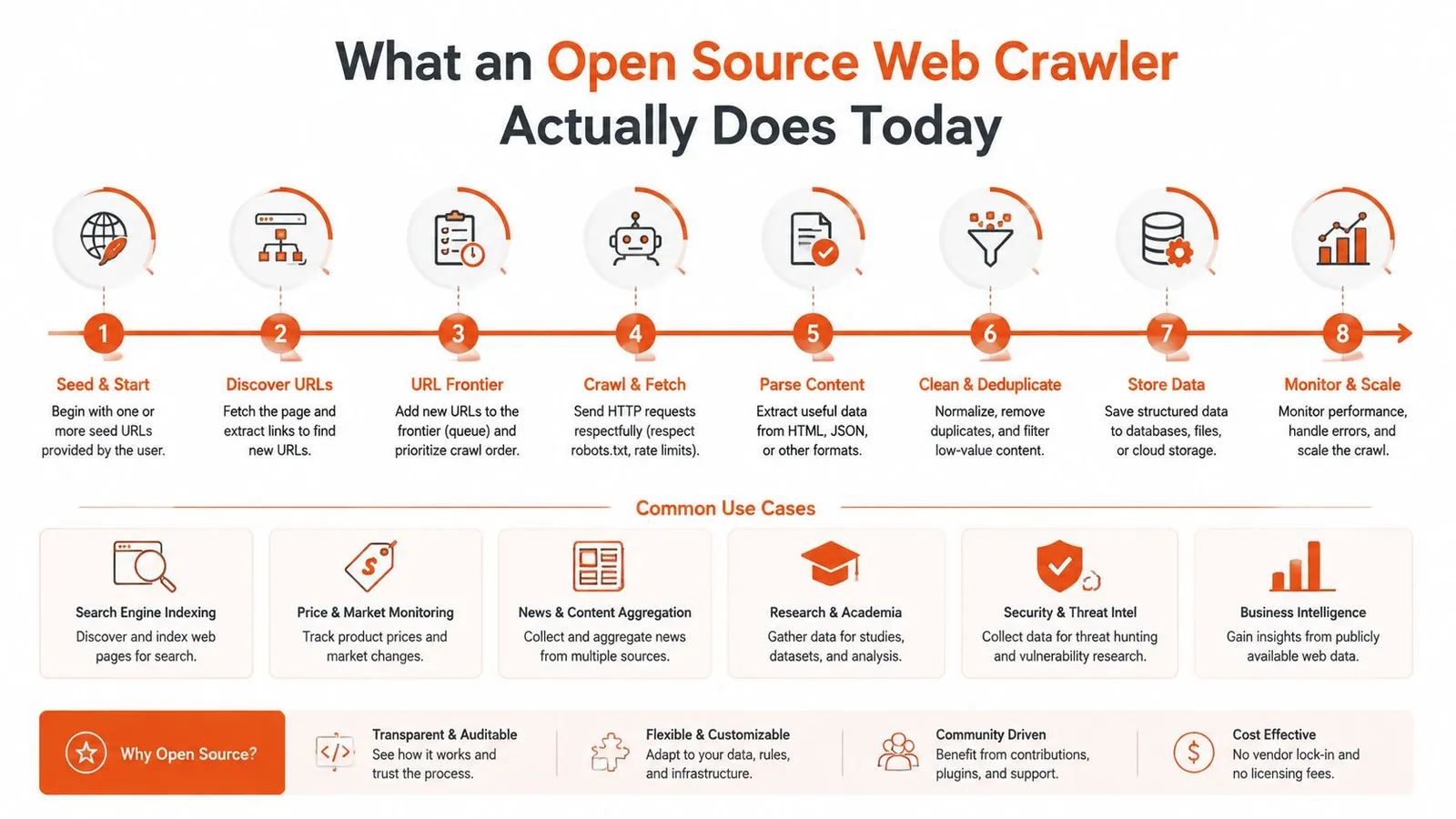
A modern open source web crawler can sit inside search, monitoring, research, or AI enrichment pipelines. In a search system, it discovers and revisits pages. In a research pipeline, it can follow links, extract the main text, and pass along compact content instead of raw HTML. In an AI system, it often has to do more, because the output must be shaped for downstream token budgets, retrieval precision, and structured extraction. That changes the cost model, because the question is no longer how many URLs a crawler can touch, but how many usable documents it produces per unit of compute and retry effort.
The primary goal isn't fetching a URL. It's turning an unreliable page into something your model can trust.
That shift is why the category got re-evaluated. Heritrix was already described as a distributed, extensible, web-scale crawler written in Java, and the project timeline shows how quickly open crawlers became production infrastructure, moving from prototype in Q2 2003 to core crawler in Q3 2003, then to a first public release in January 2004 and an official 1.0.0 in August 2004 (Heritrix timeline). The pattern still holds today. Crawling starts as a retrieval problem, then becomes a reliability problem, then turns into a cost problem once LLMs enter the loop.
For teams shipping agents and research tools, the scope goes well beyond “follow links.” It includes JavaScript rendering, content extraction, deduplication, recrawl planning, and output conditioning for LLMs. A crawler that is cheap to run but drops dynamic content, misses canonical pages, or emits noisy text ends up expensive once you count retries, manual cleanup, and bad model answers. If you want a plain-English walkthrough of the traditional crawl loop, this practical guide to a website crawler fits well with the architecture mindset here.
The takeaway is simple. If your crawler does not reliably produce usable context, the code quality barely matters, and raw URL count matters even less. The only output that counts is the document your downstream system can use.
The Core Architecture Behind Every Crawler
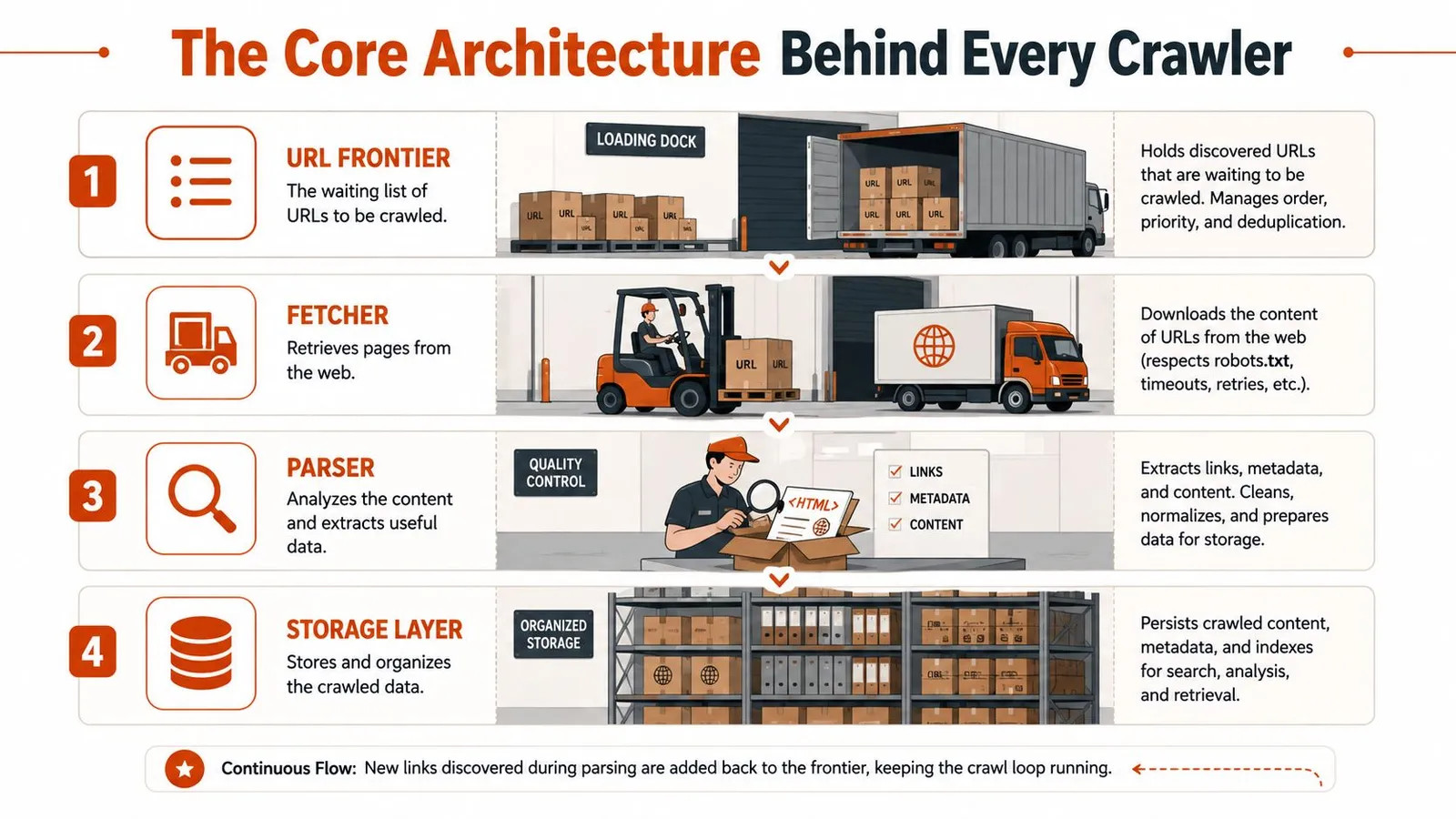
Every crawler I trust in production has the same skeleton, even when the README uses different terms. The URL frontier is the loading dock, the fetcher is the forklift, the parser is the quality control station, and the storage layer is the shelf system where the processed inventory lands. If one of those parts is weak, the whole crawl starts leaking time, bandwidth, or correctness.
URL frontier and fetcher
The frontier decides what gets visited next, and that's where politeness lives. It's also where you avoid duplicate work, because the crawler needs to know whether a URL is new, canonical, or already seen. The fetcher does the network work, but in practice it has to obey the frontier's rules about depth, domains, retries, and recrawl timing.
That's why cache validation matters so much. Norconex documents support for If-Modified-Since, ETag, If-None-Match, canonical URLs, sitemap metadata like lastmod and changefreq, plus deduplication and modified or deleted document detection, all of which reduce redundant fetches and keep recrawls focused on pages that changed (Norconex crawler docs). Its documentation also says the crawler can handle millions of pages on a single average-capacity server, which is a good reminder that crawl efficiency usually comes from frontier management and recrawl policy, not just from raw fetch speed.
Parser and storage layer
The parser is where raw responses become something useful. On a static site, that can be simple HTML extraction. On a browser-rendered site, it might mean waiting for the DOM to settle, cleaning boilerplate, and pulling only the main content. The storage layer then records the result, along with metadata that lets you revisit, diff, or reprocess it later.
If you can't explain how a crawler handles deduplication and recrawl policy, you probably don't have a crawler, you have a downloader.
The practical test is easy. Read a crawler's README and map each feature back to these four layers. If it has queue persistence, that's frontier behavior. If it has JS rendering, that's fetcher behavior. If it has CSS selectors or extraction rules, that's parser behavior. If it has export formats, snapshots, or crawl history, that's storage behavior. Once you see the architecture this way, the feature lists stop looking mysterious and start looking like variations on the same warehouse.
A crawler that gets these layers right can stay small and still hold up. A crawler that gets them wrong will feel fine in a demo and then collapse the first time it meets a real site with redirects, duplicates, or changing content.
Comparing the Major Open Source Crawlers
The field splits cleanly if you judge tools by what they do, not by star counts or launch buzz. Archival systems like Heritrix are built for large, disciplined crawls. Frameworks like Apache Nutch, StormCrawler, and Scrapy give you structure and scale. Browser automation stacks like Playwright and Puppeteer handle rendering and interaction. AI-shaped crawlers like Crawl4AI focus on output that is already closer to what an LLM wants.
The right comparison is not feature count. It is end-to-end cost per usable document, which includes how often a crawler gets through bot protection, how much cleanup the output needs, and how much operational overhead the stack adds.
| Tool | Best for | Architecture | JS rendering | Output format |
|---|---|---|---|---|
| Heritrix | Archival and web-scale crawls | Distributed crawler focused on long-running collection | Limited, not the core use case | Crawl records and archived content |
| Apache Nutch | Search-oriented crawling and indexing | Frontier-based batch crawler | Usually needs extra integration | Structured crawl outputs for indexing |
| StormCrawler | Continuous crawling on stream infrastructure | Stream processing on Apache Storm topologies | Not built in | Search and crawl pipeline outputs |
| Scrapy | Structured extraction from static sites | Modular Python framework | Not native | JSON, CSV, XML, custom items |
| Playwright | Complex pages and user flows | Browser automation | Yes | Whatever you extract yourself |
| Puppeteer | Chrome-first automation | Browser automation | Yes | Whatever you extract yourself |
| Crawl4AI | AI pipelines and local extraction | Async Python crawler with extraction strategies | Yes | Markdown, chunks, extracted content |
Where each bucket wins
Heritrix still makes sense when the crawl itself is the product, especially for archival discipline and broad collection. It is a poor fit if the main goal is LLM ingestion, because the output usually still needs extra conditioning before it becomes usable context. StormCrawler fits teams already living in stream infrastructure, where continuous URL flow matters more than a one-off crawl job.
Scrapy is the safe choice for structured extraction from server-rendered HTML. It is battle-tested, but front-end heavy sites usually force you to add browser tooling on top. Playwright and Puppeteer solve rendering and interaction, but they leave the crawling logic to you, which increases code and operational surface area.
For AI pipelines, Crawl4AI is interesting because it starts from the assumption that raw HTML is not the end goal. Its docs describe an asynchronous crawler with multiple extraction strategies, including LLM-based and CSS/XPath-based extraction, plus chunking and cosine-similarity retrieval over content chunks (Crawl4AI quickstart). That makes it more useful when the target is semantic payloads rather than page blobs.
A practical caution from the field is that a lot of comparison posts still optimize around language support, JavaScript rendering, or repo momentum. That misses the part that matters in production. The better question is whether the crawler delivers usable output with the least cleanup downstream, which is also the reason Webclaw's scraper overview treats extraction as part of the workflow, not an afterthought.
If your pipeline is mostly HTML cleaning plus schema extraction, stay with a framework that keeps control in your hands. If your pipeline feeds RAG or agents, pick the tool that already thinks in chunks, markdown, and structured output. For teams that care about collection from harder targets and want to preserve privacy via Russian server, the networking layer matters as much as the parser.
Why Most Crawlers Break on Modern Bot-Protected Sites
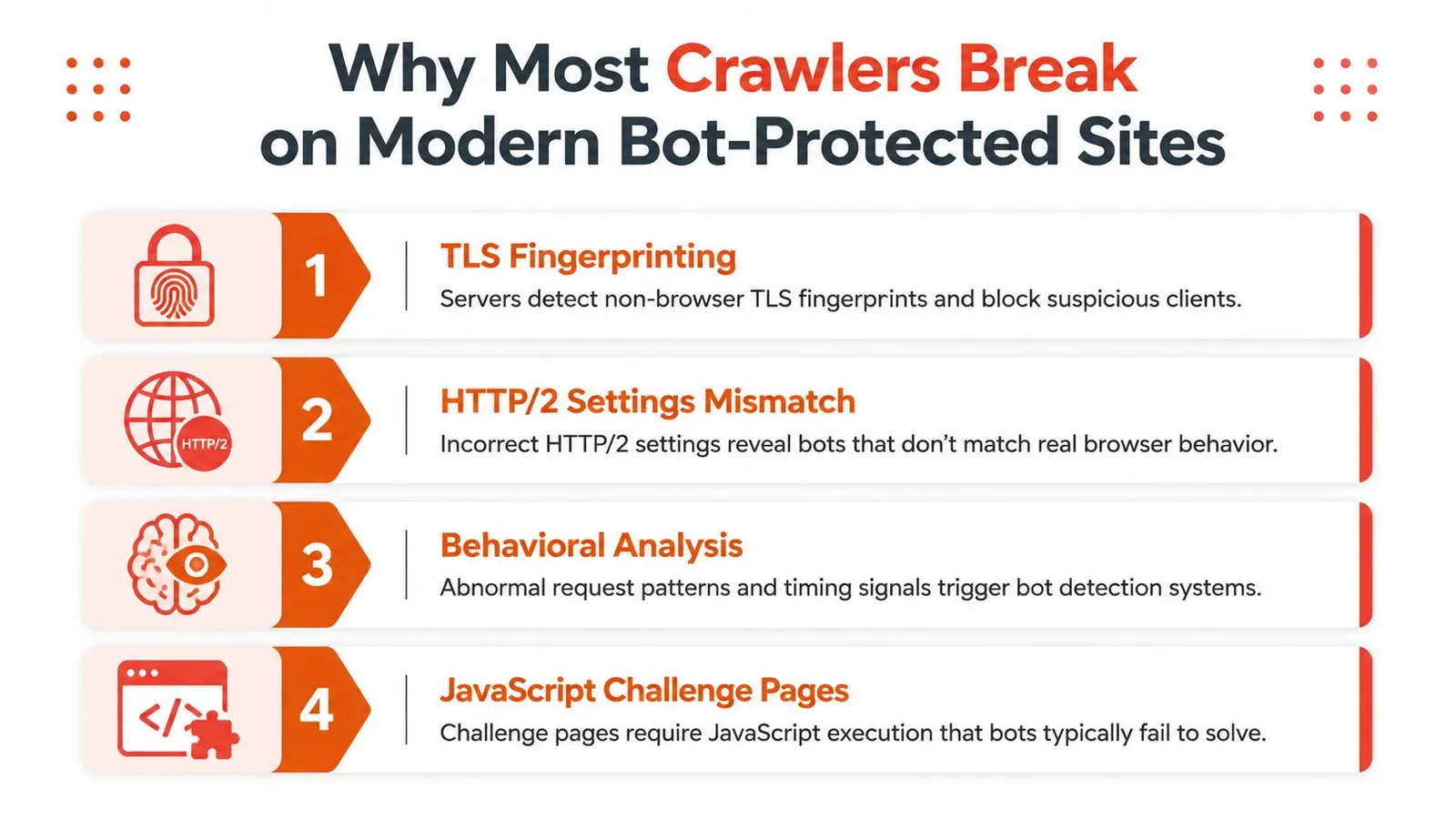
Modern defenses don't just count requests. They look at how the browser behaves, how headers are ordered, whether the TLS handshake looks normal, whether HTTP/2 settings line up, whether cookies persist in a believable way, and whether JavaScript runs like a real user session. A crawler can be perfectly polite on paper and still get flagged because its network fingerprint looks synthetic.
What failure looks like in practice
The failure modes are easy to recognize once you've seen a few of them. You get an empty page because the server served a challenge shell. You get a 403. You land in an infinite consent loop. You trip a CAPTCHA wall. Sometimes the page loads, but the important content never appears because the crawler didn't execute the right client-side path.
That's why reliability is a first-class feature, not a nice-to-have. Open source tools can handle a lot, but they don't magically solve hostile sites. Browser automation helps with rendering, session behavior, and interaction. Proxy rotation helps with distribution. Session reuse helps with consistency. None of that guarantees access on hard targets.
What open source can and can't do
A self-hosted stack can get you far when the site is only mildly defensive. If the site blocks naive HTTP fetchers but still serves content to a real browser, Playwright-based crawlers, Crawlee, or similar stacks are often enough. If the site aggressively scores fingerprints, changes challenge logic often, or requires human-like state management, you may need a hosted scraping API that includes anti-bot handling as part of the service.
That's the practical line. Open source gives you control, debuggability, and no vendor lock-in. Hosted services buy you more reach on hostile sites. The trade-off isn't ideological, it's operational.
A crawler that fails once a week is a maintenance problem. A crawler that fails on every protected domain is a design problem.
If you're diagnosing a stuck crawl, use a simple checklist. Did the page require JavaScript to reveal content. Did the site challenge the browser with a consent screen or CAPTCHA. Did the requests look too uniform. Did the crawler reuse sessions correctly. Did the site change after geo or IP context changed. Those questions usually tell you whether you need a selector fix, a browser session fix, or a different access strategy.
For teams that need a privacy-oriented route, the Russian proxy server guidance from SMS Activate is worth reading in the context of controlled geo-routing and proxy planning, even if you're ultimately using a different provider. The bigger point is that access reliability is often a network and session problem before it's a parsing problem.
If you want a tactical walkthrough for diagnosing blocked pages, this Cloudflare scraping checklist fits directly into the troubleshooting path. It's the kind of material that saves hours because it forces you to separate rendering failures from access failures.
Turning Crawled Pages Into LLM-Ready Context
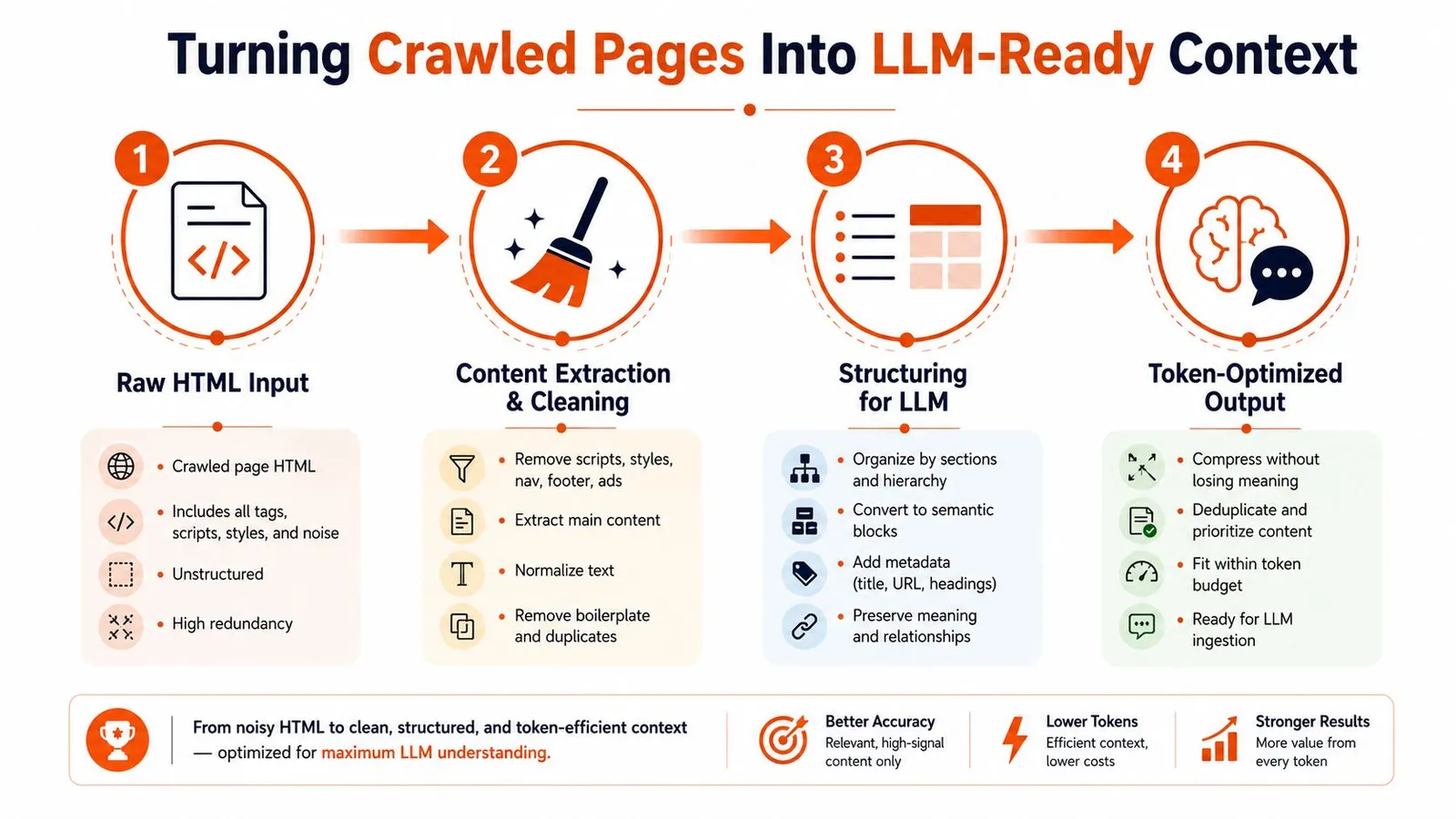
Raw HTML is a poor default for language models. It pulls in navigation, footers, cookie banners, ads, hidden elements, and repeated boilerplate, so you spend tokens on noise instead of useful text. Browser-rendered pages can make that worse, because the DOM often contains even more clutter by the time the page settles. The crawler's job is to strip that out before the model ever sees it.
Extraction before retrieval
The first move is extraction. CSS selectors and XPath work well when the site structure is predictable, and they stay easy to debug when something breaks. LLM-based extraction helps when the page structure is messy or inconsistent, because the model can infer fields from surrounding context instead of fixed DOM positions. In production, the strongest pipelines keep both options available, because site layouts change and a single parsing strategy rarely survives every page type.
The second move is cleaning. Strip boilerplate. Deduplicate repeated blocks. Keep only the main content when the target is an article, docs page, or product description. The more you remove before chunking, the fewer irrelevant tokens you push downstream. That matters most on long pages, where the useful text sits between menus, sidebars, and repetitive wrappers.
Chunking and semantic targeting
The third move is chunking. Good chunking turns a long page into smaller units that a retriever can rank without forcing the model to read the entire document. That is the part many teams underestimate. A page that is technically fetched but poorly conditioned still produces expensive, low-value context.
The fourth move is deciding when browser rendering is worth the cost. If the page is static and the content is already in the HTML, browser overhead is wasted work. If the page is client-rendered or interaction-heavy, the browser is the price of admission. The practical approach is to render only the pages that need it, because every extra browser session raises compute cost and operational weight.
For teams that need a clear treatment of HTML cleanup before model ingestion, the HTML-to-Markdown conversion guide for LLM pipelines covers the same conditioning problem from the output side. That step matters because markdown, cleaned text, and structured chunks are much easier to rank, store, and feed into retrieval than raw page markup.
A useful operating model is to treat the crawler as a context compressor. It reduces page noise before the LLM spends tokens on it. That is why content-first pipelines matter in large-scale data prep, and why the Spark and Hadoop guide for enterprise AI fits the same conversation about downstream processing. The common issue is simple, the data prep layer decides whether the model spends its budget on signal or clutter.
If a page can be reduced to a few clean sections, do that before you ask a model to reason over it.
The best output is the one your retrieval layer can rank and your model can read cheaply. Everything else is overhead.
How to Choose and Deploy the Right Crawler
Start with the workload shape. If you need broad discovery across many pages with modest complexity, a framework like Scrapy or Colly is still hard to beat. If the target is browser-heavy, choose Playwright, Puppeteer, or Crawlee. If the output is going into an LLM, pick a crawler that already emits markdown or structured chunks. If you're doing continuous crawling inside existing stream infrastructure, StormCrawler belongs in the conversation.
The three questions that matter
What's the workload? A docs site, a news archive, and a JavaScript app all want different machinery. Don't overspend on browser sessions if HTTP extraction is enough.
What does reliability mean? If “reliable” means “works on friendly sites,” many tools qualify. If it means “reaches pages that block naive fetchers,” you need browser behavior, session control, and possibly a hosted access layer.
What is the cost per usable document? That's the question often skipped. Throughput only matters if the result is usable. A fast crawler that hands your model 10 pages of junk costs more than a slower crawler that hands over one clean document.
Deployment patterns that hold up
A small scraper in a sidecar is fine for one-off jobs or product surfaces that only need a few pages. A frontier-based crawler behind a queue is better when multiple workers need to share progress and retries. A browser pool makes sense for JS-heavy targets, but only if you accept the memory and orchestration overhead that comes with it.
If you want a fully managed option, Webclaw is one of the tools that fits the AI-oriented side of this problem. It exposes crawl, map, and extraction workflows through an API, and it's built around turning pages into compact context rather than raw HTML. That matters when your downstream system cares more about usable documents than about total URLs fetched.
Start with the smallest tool that clears your reliability bar, then measure token cost before you measure crawl speed.
If self-hosting is starting to absorb more engineering time than it saves, that's the point to stop. The Webclaw self-hosting docs at this deployment guide are useful if you're deciding whether you want to run the crawler yourself or use it as a service interface. The right choice is usually the one that leaves your team spending less time debugging infrastructure and more time using the output.
Putting It All Together
Pick the crawler that matches your workload shape, your reliability requirements, and your end-to-end cost per usable document. Evaluate those factors on your own target set.
The recurring pattern is consistent. Open source works best when the crawler architecture is sane, the access model fits the target site, and the output is conditioned for whatever consumes it next. If the downstream consumer is an LLM, raw HTML is usually the wrong artifact. If the site is protected, success depends on more than link following. If the crawl is large, frontier policy and recrawl behavior matter as much as fetch speed.
A good operating checklist is short. Start small. Prefer the simplest crawler that meets your reliability needs. Measure the size and quality of the usable document, not just the number of pages fetched. Only move to a distributed crawler or a hosted API when the extra operational lift clearly pays back in reliability or context quality.
If you're building AI retrieval pipelines, agent workflows, or research systems and you want a crawler that returns compact context instead of noisy HTML, take a look at Webclaw. It's built for crawling, mapping, and extraction on pages that are hard for naive fetchers, and it's meant to drop clean web data into the rest of your stack without a lot of cleanup.