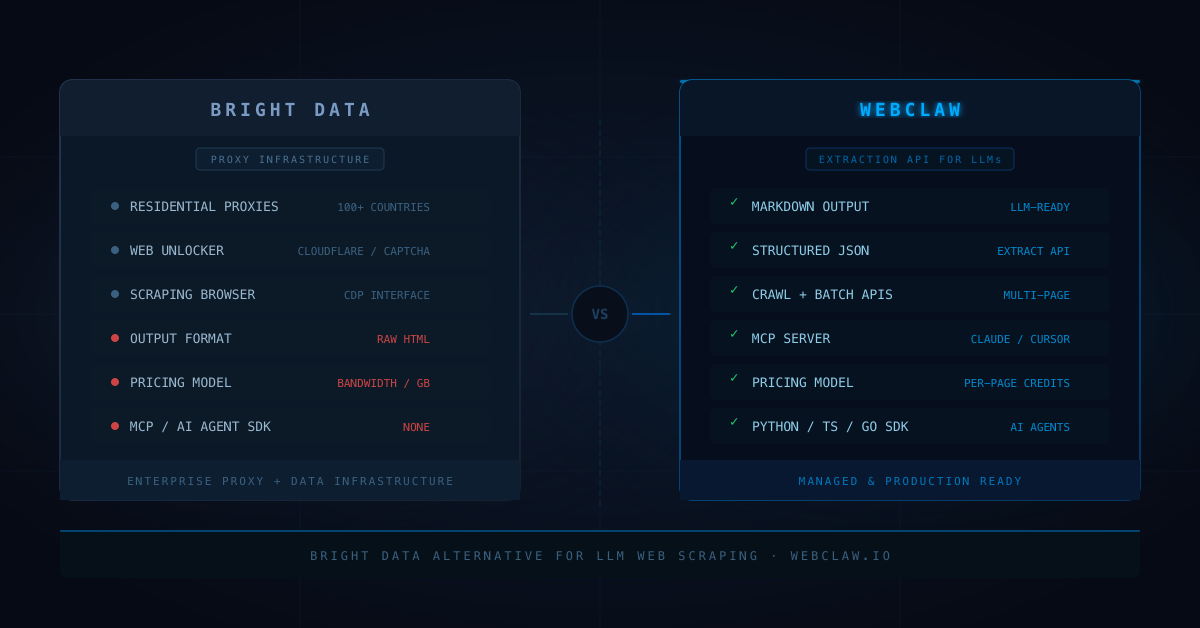
Bright Data Alternative for LLM Web Scraping
Bright Data is the largest proxy network in the world.
That is not marketing. Their residential network is enormous. Their Web Unlocker handles Cloudflare, DataDome, and other bot protection systems at a scale that almost nobody else matches.
If your team needs proxies and data at enterprise volume, Bright Data is a serious tool.
But if you are building an LLM application, an AI agent, or a RAG pipeline that needs clean web content, you are not primarily shopping for a proxy network.
You are shopping for a web extraction API.
That is a different product.
This post covers where Bright Data excels, where it creates friction for LLM workflows, and when a Bright Data alternative is the better call for teams building with AI.
For the product comparison, see Webclaw vs Bright Data.
Quick answer
Use Bright Data when your problem is proxies at scale: residential IPs, ISP proxies, mobile proxies, geo-targeting, or enterprise data collection contracts.
Use Webclaw when your problem is web extraction for AI:
clean markdown for LLMs
structured JSON extraction
multi-page crawling
batch scraping
MCP access for Claude and Cursor
AI agent SDK integration
per-page pricing without bandwidth surprisesThe difference is not about which tool is better in general.
It is about what kind of infrastructure your AI application actually needs.
If you want to see the extraction side before reading further, open the web scraping API demo and run a page through it.
What Bright Data is actually good at
Bright Data built its business on proxy infrastructure.
Their residential proxy network covers 100+ countries. Their datacenter and ISP proxy options give you clean IPs with predictable behavior. Their Web Unlocker service handles JavaScript rendering, CAPTCHA solving, and browser fingerprinting in one managed endpoint.
For teams that need:
geo-targeted data access
residential IP rotation at scale
enterprise-grade SLAs
large-scale data collection contracts
SERP data pipelines
social media monitoring at volumeBright Data is a serious choice.
The Bright Data Scraping Browser also exposes a CDP interface for browser automation through their proxy infrastructure. Their Datasets product lets you buy pre-collected data directly. These are real products with real engineering behind them.
Where Bright Data gets painful for LLM workflows
The pain is usually not technical. It is structural.
Bright Data is priced by bandwidth and proxy tier, not by page extraction.
If your LLM application needs 10,000 pages per month at consistent quality, you are managing GB quotas, proxy pool selection, request routing, and output formatting yourself.
The Web Unlocker returns raw HTML.
Your application still needs to convert that HTML to markdown, remove boilerplate, extract structure, handle JavaScript shells, score content quality, and retry failed URLs.
For a traditional data pipeline, you probably have that processing layer already.
For an LLM application that needs to feed clean text to a model or vector database, you are building extraction infrastructure that is not in the product.
This is what creates friction:
pay for bandwidth even when the page returns garbage content
build markdown conversion yourself
handle retry logic and failure classification yourself
route requests per proxy tier manually
no MCP server or AI agent SDKThe product was designed for data engineering teams, not for teams building AI-native applications.
Proxy-first vs extraction-first
Most web scraping tools were designed around the proxy problem.
Route requests through enough IPs and you get the raw HTML.
For LLMs, the proxy problem is only one step.
You also need:
content classification
boilerplate detection
main content extraction
markdown conversion
link and metadata preservation
structured JSON output
quality scoring
JavaScript rendering decisions
crawl orchestration
batch schedulingWebclaw is designed around the extraction job, not the proxy job.
The proxy routing, TLS fingerprinting, bot protection bypass, and residential fallback are handled inside the API. You never configure proxy tiers or manage bandwidth quotas.
You get clean markdown or structured JSON per page, at per-page pricing.
This is the argument from our JavaScript rendering API guide applied to the whole stack: the browser, the proxy, and the rendering decision should all be behind the API, not in front of it.
Crawling, batch, and structured extraction change the cost model
A single URL is easy in any tool.
A production AI workload is different.
If your RAG pipeline needs to crawl a docs site weekly, your price monitoring agent watches 500 products daily, or your AI researcher needs batch extraction from a URL list, the pricing model matters as much as the extraction quality.
Bright Data bills by GB transferred through their proxies plus the platform fee.
Webclaw bills per page extracted.
For a job that crawls 1,000 pages, you know the Webclaw cost before you start. You pay for 1,000 pages.
With Bright Data, the cost depends on how much HTML each page transfers, how many retries the proxy layer needs, and which proxy tier handles each site.
For unpredictable page sizes and site difficulty, the per-GB model creates billing surprises for AI workloads where extraction count is the natural unit of measurement.
Bright Data alternative decision table
| Need | Bright Data | Webclaw |
|---|---|---|
| Residential proxies at scale | Strong | Handled inside the API |
| Geo-targeted access | Strong | Locale-aware extraction |
| Enterprise proxy contracts | Strong | Not the use case |
| Web Unlocker for anti-bot pages | Strong | Managed at the extraction layer |
| Clean markdown output | Requires custom processing | Built in |
| Structured JSON extraction | Requires custom processing | Built in via Extract API |
| Multi-page crawling | Scraping Browser + custom logic | Built in via Crawl API |
| Batch scraping | Custom implementation | Built in via Batch API |
| MCP for Claude and Cursor | No | Built in via MCP server |
| AI agent SDKs | No | Python, TypeScript, Go |
| Pricing model | Bandwidth + platform fee | Per-page credits |
| Best fit | Enterprise proxy and data infrastructure | Web extraction API for LLM applications |
Code comparison
Bright Data Web Unlocker gives you a connection to the page, not the content:
import requests
response = requests.post(
"https://api.brightdata.com/request",
headers={"Authorization": f"Bearer {token}"},
json={
"zone": "unlocker",
"url": "https://example.com/article",
"format": "raw"
}
)
# returns raw HTML. markdown conversion is your problem
html = response.json()["html"]Webclaw returns markdown, structured data, and metadata in one call:
from webclaw import WebclawClient
client = WebclawClient(api_key="YOUR_KEY")
result = client.scrape(
url="https://example.com/article",
formats=["markdown", "json"]
)
print(result.markdown)
print(result.metadata.title)For a full site crawl:
job = client.crawl(
url="https://docs.example.com",
limit=100,
formats=["markdown"]
)For schema-shaped extraction:
result = client.extract(
url="https://example.com/product",
prompt="Extract name, price, variants, and availability"
)
print(result.json_data)The difference is what you get back.
Bright Data gives you a connection to the page.
Webclaw gives you the content the model needs.
When I would still use Bright Data
Bright Data makes sense when:
the job is proxy infrastructure at enterprise scale
the team has existing data engineering tooling
the use case is residential IP rotation at high volume
the product already processes raw HTML internally
geo-targeting is the core requirement
the contract is with a data team, not a product teamIf your company buys data at scale and already has extraction pipelines, Bright Data is the right infrastructure conversation.
When I would use Webclaw instead
I would use Webclaw when:
the product is an LLM application or AI agent
the output needs to be markdown or typed JSON
the workflow needs crawl, batch, or extract APIs
the same tool needs to serve Claude, Cursor, or other MCP clients
the cost model needs to be per-page, not per-GB
the team does not want to operate proxy infrastructure
JavaScript rendering should be a fallback, not a configurationThat is why Webclaw exists.
Not to replace a proxy network. To replace the infrastructure you would build on top of one.
For more context, read Best Web Scraping API for LLMs, RAG Pipeline with Live Web Data, and Jina Reader Alternative for LLM Web Scraping.
The rule
Use the tool that owns the output format your system needs.
If your system needs residential IPs at enterprise volume, Bright Data is a strong answer.
If your system needs clean web content for a language model, the proxy layer is already inside your extraction API.
You do not need to manage both.
Building an LLM app and tired of processing raw HTML? Start with the 7-day Starter trial or grab an API key. If you are coming from a proxy setup, the Scrape API returns the markdown and JSON your model needs without the bandwidth math.
Frequently asked questions
What is the best Bright Data alternative?
The best Bright Data alternative depends on the use case. For enterprise proxy infrastructure, few services match Bright Data's scale. For LLM applications, RAG pipelines, and AI agents that need clean markdown and structured JSON from web pages, Webclaw is a more focused extraction layer.
What are the main Bright Data alternatives for web scraping?
The main Bright Data alternatives are Oxylabs, Smartproxy, and Zyte for proxy-first workflows. For extraction-first workflows built around LLMs and AI agents, Webclaw, Firecrawl, and Jina Reader are the relevant alternatives.
Is Bright Data good for RAG pipelines?
Bright Data can supply raw HTML for a RAG pipeline, but you still need extraction, markdown conversion, chunking, and metadata handling yourself. For teams that want those steps managed by the API, a dedicated extraction tool is a better starting point than a proxy service.
How much does Bright Data cost?
Bright Data pricing is based on bandwidth per proxy tier plus monthly platform fees. Costs vary depending on proxy type, volume, and data collection needs. Per-page pricing tools like Webclaw are more predictable for AI workloads where extraction count matters more than bandwidth transferred.
Can Bright Data handle Cloudflare-protected sites?
Yes. Bright Data's Web Unlocker is designed for bot-protected pages including Cloudflare, DataDome, and other anti-bot services. For teams that want this handling inside an extraction API that already returns clean markdown, Webclaw manages the same classification and fallback without manual proxy tier selection.
When should I use Webclaw instead of Bright Data?
Use Webclaw when your application needs web content in a format models can use directly: markdown, structured JSON, or MCP tool output. Bright Data is the right layer when the core need is proxy infrastructure, IP rotation, or enterprise data collection contracts.